Simulate the public.
Before you go public.
See how your market reacts to a launch, campaign, or message, in minutes, for a fraction of the cost of traditional research - and before you lose the moment.
You only find out how it lands after you’ve spent.
Launches, campaigns, and announcements are bets. Traditional research takes weeks to come back. A survey only captures a single moment. None of these can tell you how people would react if you changed the message, the timing, or the approach.
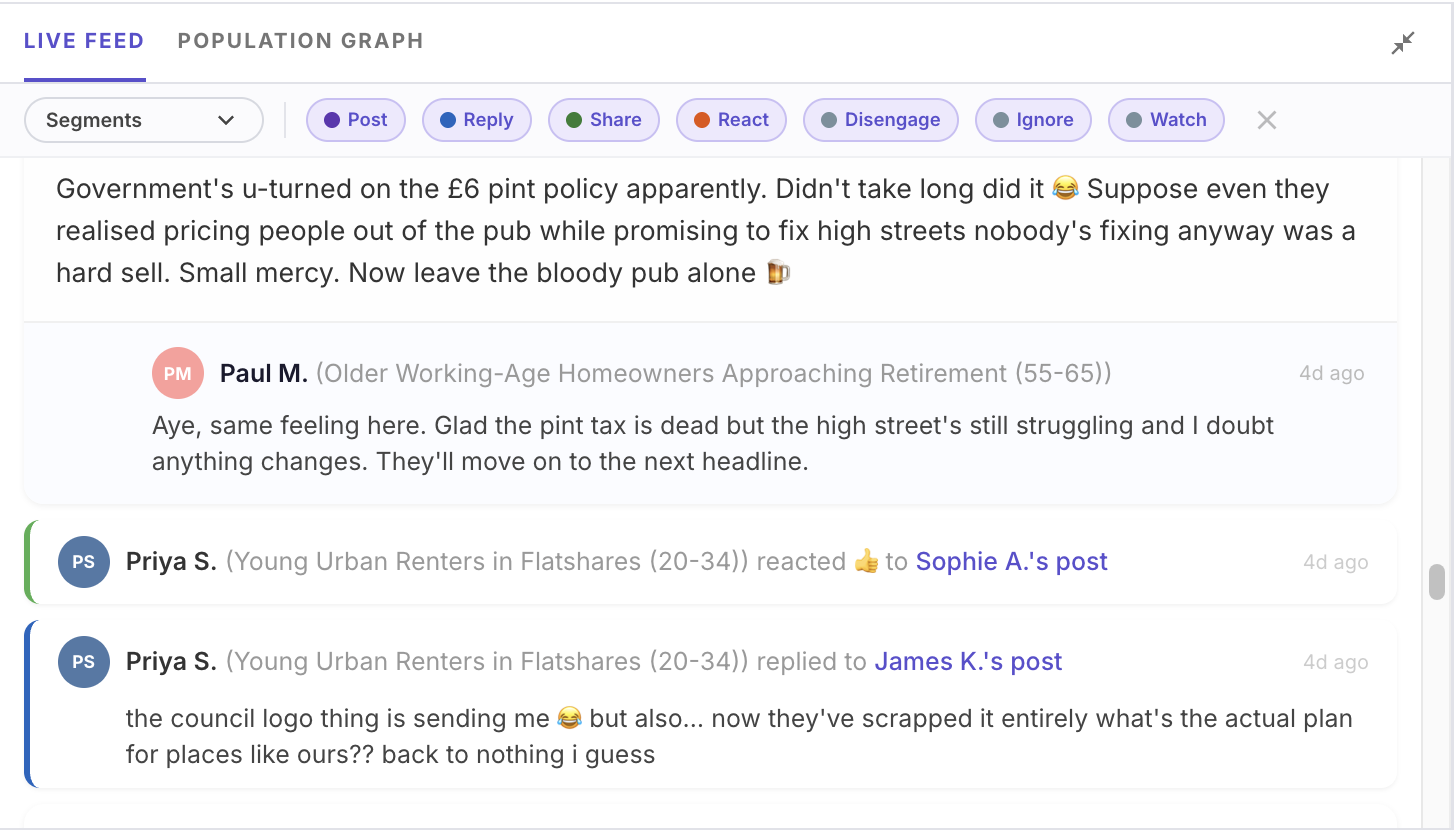
Real audiences react in motion: they respond to each other, coalitions form, opposition mobilises. By the time you’ve tested your options the old way, the moment to act on them has passed.
Find the version that wins before the market ever sees it.
Put your idea in front of a market
A campaign, a price change, a policy, a single post. Ripple builds a population that mirrors your real audience and runs your idea past every part of it in minutes.
See exactly where the value leaks
Watch who buys in, who pushes back, and who quietly changes everyone else's mind. Catch the line that wins support and the one that sparks the backlash, before either reaches a real person.
Leave with the version that pays off
The specific changes that lift support, defuse the risk, and turn an expensive maybe into a confident yes, written up ready to take into the room.
Simulate audiences. Watch them react. Read off the outcome.
“How would UK pub-goers respond to a £6 minimum price on a pint, with the extra revenue funding local high-street regeneration?”
The audiences
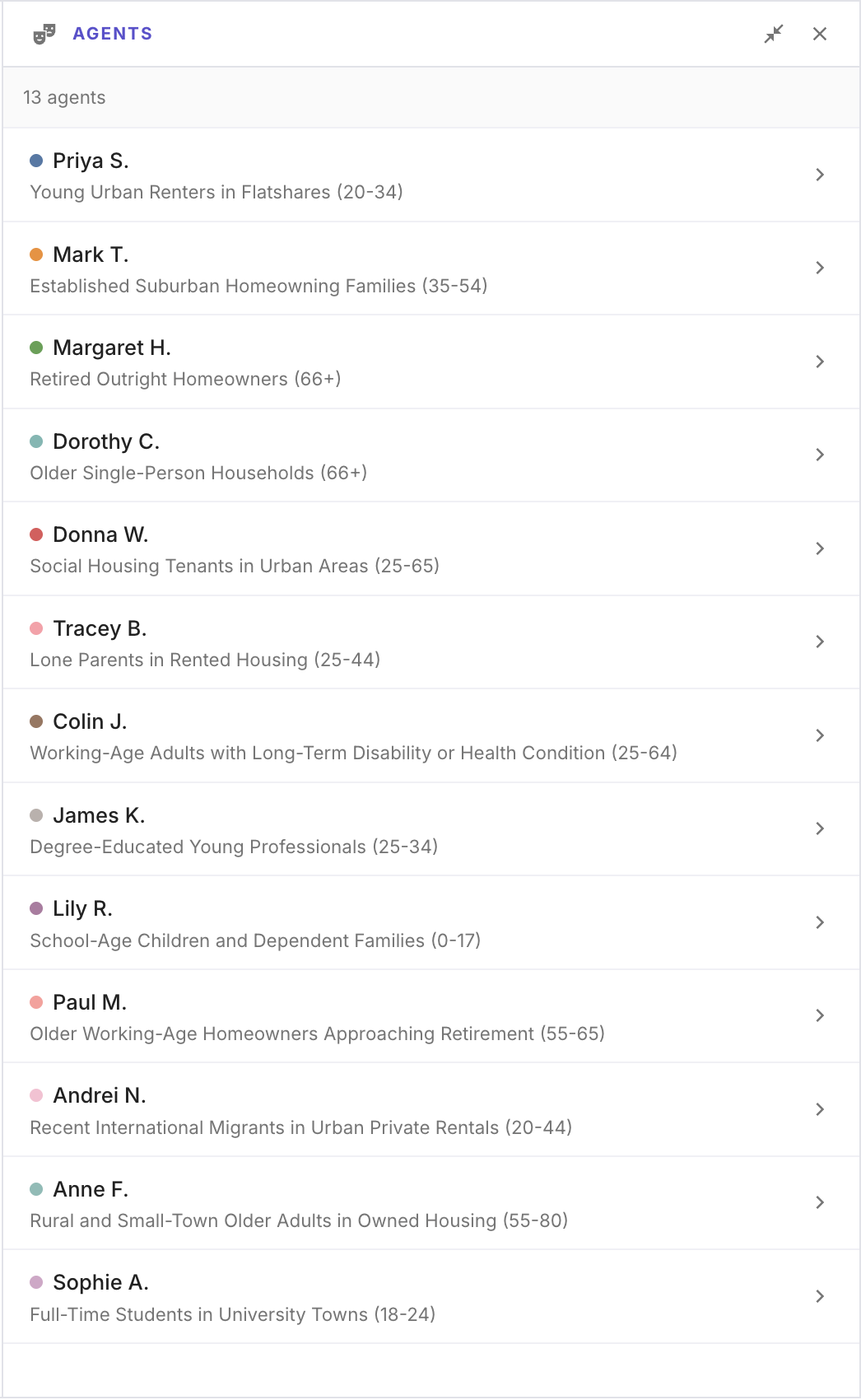
Priya S.
AmbivalentYoung Urban Renters in Flatshares (20–34)
7.2M people
Mark T.
OpposedEstablished Suburban Homeowning Families (35–54)
9.2M people
James K.
ConditionalDegree-Educated Young Professionals (25–34)
5.3M people
Plus 10 more segments — 13 in total, covering 72 million people, mirroring the UK pub-going public.
How they react
Priya S.
· Posted in the first 6 hours
“like yes our high street is a shell of itself and i hate it. but also i’m already spending half my income on rent and now every friday is gonna cost me an extra tenner?? the logic is there but the timing is not it”
Mark T.
· Posted in the first 6 hours
“So they want to tax the pub to fix the high street the council already ran into the ground. Just another way to price ordinary people out of the one thing they actually enjoy after a long week”
James K.
· Posted in the first 6 hours
“has anyone seen a council regeneration fund that didn’t end up paying for consultants and a new logo for the high street 😂 conditionally open to it but mate, show me the receipts first”
The outcome
Net sentiment by wave
First 6 hours
−0.81
Hours 6–19
−0.38
Days 1–2
−0.20
Days 2–4
−0.11
The verdict
Rejected almost universally on arrival — and the government’s u-turn defused the anger but solved nothing. By day four, 47% of the population had disengaged: relieved, cynical, and braced for the policy to return.
Download the sample report (PDF)For marketing and brand teams.
Test how a campaign, message, or brand move will land across your market, long before the media spend.
Find the message that lands
Watch which lines win attention and which get ignored, then take the version that already works to market.
Spot the backlash early
Surface the criticism and the awkward read before it plays out in public, while it still costs nothing to change.
Brief with evidence, not opinion
Give the team and the client a clear read on reaction by segment, in place of a gut call.
Realistic enough to act on, because every agent is modelled on real human behaviour.
Each agent's personality is grounded in a real psychological survey of ~1,520 people — OCEAN plus eight psychographic families, measured rather than invented.
Conversation runs as a multi agent network, so opinion clusters, vocal minorities, and fading engagement emerge on their own.
1,520
real survey respondents with diverse backgrounds
84
psychographic dimensions measured
9
trait families (OCEAN + 8)
86%
agent–human agreement, in published research
See it in action.
The simulated population at a glance
Posts, replies, and reactions as they unfold
Findings and risk flags you can act on